

For 2,500 years Zoroastrians left their dead outside to be consumed by carrion birds. The idea behind the dakhma cemetery (Persian: دخمه) was to avoid contaminating the soil and the fire, both of which are considered sacred to Zoroastrians.
The place they ceremonially laid out the bodies is called also known as the Tower of Silence, consisting of a perfectly symmetrical flat-topped stone tower, where the bodies were laid out for days for the birds to feast upon.
The leftover bones were then burned. This practice was abandoned in the 1960s and the dead now are buried in a Zoroastrian cemetery nearby.

The mind-boggling scenery around the Zoroastrian Dakhma
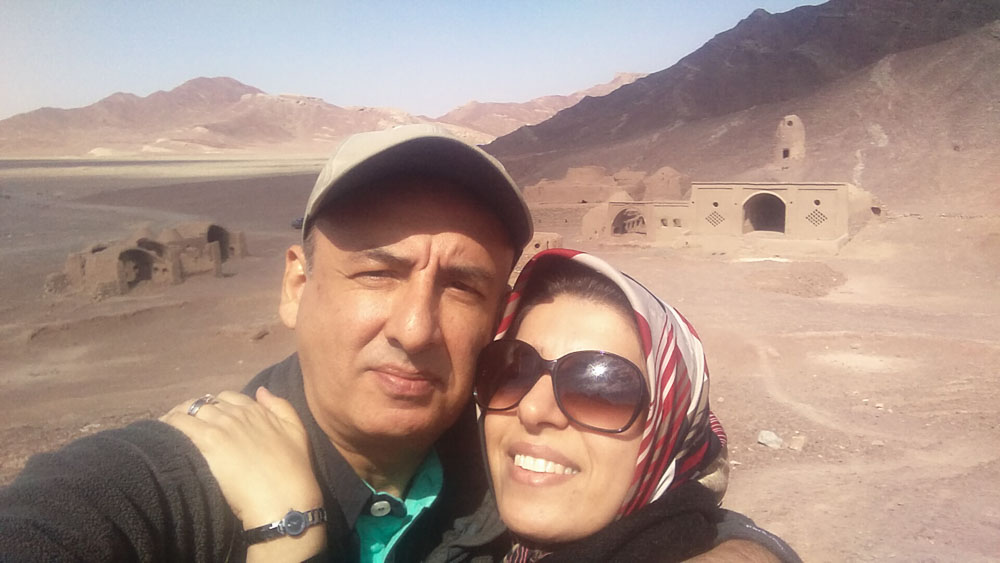
As we approached the tower in the empty desert, Saeideh and I were delighted not find a single soul around (at least none in flesh). Being able to explore history on your own – without the ticket booths and the masses of growling tour buses – is a special part of travelling in Iran.
But when we got to the top of Zoroastrian Dakhma, history had to take a backseat. It was the 360-degree mountain scenery – and the scale of the flat, arid valley surrounding us – that kept us enthralled.
Okay, yes, lots of human bodies were consumed here. I felt that I needed to focus on that, maybe say something philosophical. But instead our attention was drawn to the mind-boggling scenery, accompanied by the howl of the wind.
From up there, you can see trucks and buses rolling on highways miles away, appearing like tiny insects next to giant blue-tinged rocky mountains hovering over the valley.

“The people in the buses and the trucks – they all eventually end up here [in a cemetery] no matter how fast they drive away,” Saeideh said. “The mountains – they will live on for a long long after we’re gone.”

How to get to the Dakhma
There are two well-known dakhmas in Yazd. We went to the lesser-known one near Cham, on the road between Taft to Yazd, because it’s a much shorter climb to the top.
It is near the town of Cham, about 22 KM southeast of Yazd.
History known to Europeans
It was the photographs made by 19th century German researchers of the bodies laid out on the dakhma that fascinated so many Europeans about Zoroastrianism.








Leave a Reply