
Swimming on a hot summer day is good. Swimming under the desert in a 2,500-year-old qanat in northeast Iran is extra special.
I am 15 meters below ground, inside one of the world’s oldest qanats (aka kārīz) – the system of underground canals and aqueducts ancient Persians invented to transport water from mountains to the desert.


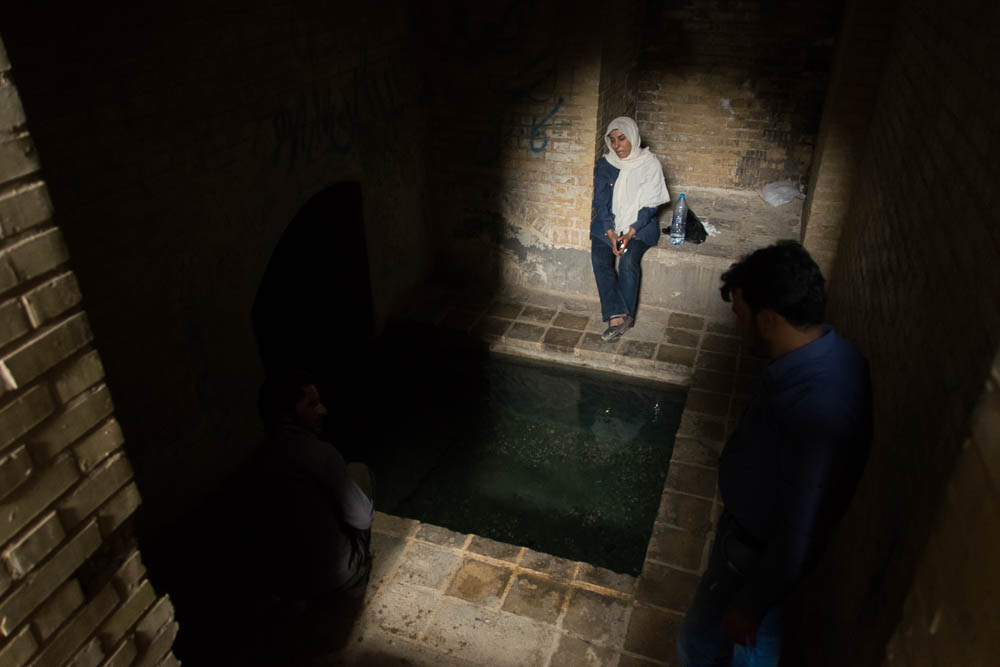
The Ghasabe (a.k.a.Qasabeh) Qanats of the town of Gonabad, in northeast Iran, are some of the oldest and largest qanats in the world, built between 700 BC to 500 BC by Cyrus the Great and other kings. Last year the qanats were inscribed as a UNESCO World Heritage Site called the “The Persian Qanat“.
This is one of the privileges of travelling in Iran: in a tiny dusty town, far from hustle and bustle of touristy and overcrowded Isfahan and Shiraz, I get to take my clothes off and take a dip in an ancient museum piece. Try that in Europe or the U.S. and you’re bound to get arrested.
Stumbling on history is one of the pleasures of road-tripping through Iran. You run into the unexpected all the time in a land that has been seen many civilizations come and go for thousands of years.
Once waist deep inside the cool water, I turn on a flashlight and start walking in the channel that snakes under the desert for more than 33 km with the aid of 472 access shafts. It’s essentially a giant man-made aquifer under the ground, running on nothing by gravity.
Iran Qanat tour: more about Ghasabe Qanats
At its beginning the channel is 300 meters under the ground! Somehow – and no one’s entirely sure how they managed this with the technology of 2,500 years ago – the shaft remains nearly level its entire length, as it transports 150 liters of water per second to this location, and from here to locations in and around Gonabad (go-NAW-bawd).

I walk the channel about 50 meters, sloshing over soft moss, before Saeideh gets nervous and begs me back. I turn off the flashlight. It’s pitch dark. There’s a deep hum in the background. I am reminded of the spaceship air shafts in the movie Alien (1979), where the creature hunted the captain.
A local tells us every summer Europeans visit to walk the qanat. “They seem to know more about how the qanat works than us Iranians,” he says. “Once I saw a Frenchman on TV explaining it for an entire hour.”
Later, at the Gonabad Museum of Anthropology we find out qanat-related jobs are common in this part of the country because qanats are so commonplace.


What we didn’t see were the much larger and taller tunnels further out, which are open to the public only on special occasions. The photos are breathtaking. We have to come back.







Leave a Reply